2021 Volkswagen Passat Alltrack review | Price, Features, engine, fuel use, Safety

[ad_1]
The German brand’s newest arrival blends the best of both worlds and draws parallels to an old Aussie favourite.
If you’re willing to swim against the SUV tide, this could be the car for you.
Volkswagen has brought back its Passat Alltrack wagon after a brief hiatus, although the formula has changed.
Instead of a frugal diesel engine, the new model is powered by a 2.0-litre turbo petrol that gives it a sportier character.
Those feeling nostalgic for the Holden Commodore Sportwagon could find the Alltrack the right car to fill the void.
It’s no rocket ship, but with 162kW of power and 350Nm of torque — delivered low in the rev range — it has more than enough performance for overtaking and gobbling up the kilometres on the freeway.
Owners swapping the old model for the new will need to brace themselves for more frequent and expensive fuel stops if they’re planning to do some long-distance touring. The old model’s fuel label claimed 5.4L/100km, while the new model is 8.0L/100km.
We managed less than eight on the freeway, but around town in heavy traffic we saw low to mid-teens.
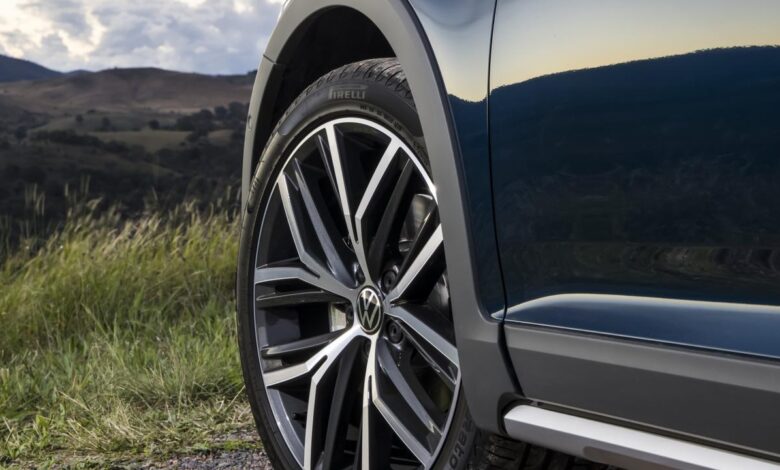
The Alltrack is still more softroader than 4WD but all-wheel-drive traction, clever electronics and slightly more ground clearance (173mm versus 142mm for the standard Passat wagon) make it capable of tackling the odd dirt road. It looks the part too, with flared wheel arches and largely decorative aluminium bash plates on front and rear bumpers. Unlike the Tiguan SUV, it has a full-size alloy, as well as tyres that can re-seal themselves after a small puncture.
It also feels bigger inside than the Tiguan, with more rear leg room and a larger and longer load area for swallowing flat packs and camping equipment. The rear seats flip at the pull of a lever.
Rear occupants are well looked after with individual vents, climate controls, a USB-C port and a 12-volt outlet.
There are two variants available. The cheaper model starts at $46,990, which would land it in the middle of the Tiguan price range, while a fully loaded Premium version is $58,790. If you want a colour other than white, it will set you back another $800.
Both models have the same level of standard safety equipment. The Alltrack will steer you back into your lane, warn you of vehicles in your blind spot, keep a safe distance to the car in front and alert you if you’re backing out of a parking spot into passing traffic.
If a crash becomes inevitable it will prepare the cabin for impact by shutting the windows and tightening the seat belts.
The cheaper model has a smaller centre screen and doesn’t have the digital cockpit that is now standard on cheaper models in the Volkswagen range but the cabin presentation is still above par. The cloth and suede seats are comfortable and supportive and the infotainment is easy to operate.
Wireless Apple CarPlay and Android Auto are standard, but we found CarPlay glitchy. This is not unique to Volkswagen — every car we’ve tested with wireless CarPlay has had issues. The absence of wireless phone charging also means it would be prudent to pack a USB cord.
It’s a big price hike to the Premium model but there’s plenty of equipment to justify the extra spend. Big-ticket items include the digital cockpit, heated and cooled leather seats, a high-end Harman Kardon audio system, a panoramic sunroof and ambient cabin lighting.
The Premium also has matrix headlights that can light up the road ahead without dazzling oncoming traffic.
On the road, the Alltrack feels planted and composed.
Adaptive suspension is standard, allowing you to choose stiffer suspension for more control through corners or a softer set-up for soaking up bumps and corrugations on dirt tracks.
Sharp steering, a lively turbo four and a quick-witted seven-speed dual-clutch auto (up from six on the previous model) add to the driver enjoyment.
The ride can feel a little lumpy at low speed on pockmarked city streets, but overall the Alltrack is a comfortable and quiet place to spend time behind the wheel.
VERDICT 3.5/5
The Alltrack is a welcome alternative to SUVS — roomy, well-priced and fun to drive.
VOLKSWAGEN PASSAT ALLTRACK VITALS
Price: From $46,990 drive-away
Warranty/servicing: 5 years, unl’td km, $3493 over 5 years
Engine: 2.0-litre turbo 4-cyl, 162kW/350Nm
Safety: Nine airbags, auto emergency braking, blind-spot assist, lane-keep assist, radar cruise control, rear cross-traffic alert
Thirst: 8.1L/100km
Luggage: 650 litres
[ad_2]
Source link