
In a meat processing plant, the areas that look the messiest are not necessarily the ones that deserve the most attention. A visible piece of product on an open floor is easy to notice. Residue caught beneath a conveyor component or moisture sitting around a drain is much easier to miss.
That distinction matters because contamination risk is shaped by more than appearance. It is influenced by where raw meat travels, which surfaces repeatedly touch product, how water moves through the plant and how people and equipment pass between different processing areas.
Understanding these patterns gives cleaning teams and plant managers a clearer picture of where attention is most valuable. Rather than treating every room and surface as though the risk were identical, it makes sense to look at how each area is used and what could carry contamination from one point to another.
Table of Contents
Raw Meat Receiving and Handling Areas
The journey begins where raw meat enters the processing environment. Receiving and initial handling areas experience frequent contact with incoming product, containers, pallets and transport equipment.
During unloading and transfer, liquid and small pieces of organic material can reach floors, equipment and nearby surfaces. Trolleys and containers may then move onwards which means the concern is not limited to the place where the product was first received.
This makes receiving areas important transition points. Cleaning needs to consider doors, floors, trolley wheels, handles and other frequently contacted surfaces as well as the main unloading space. Looking at the direction in which products and equipment travel can reveal possible pathways that would otherwise be easy to overlook.
Cutting and Trimming Stations
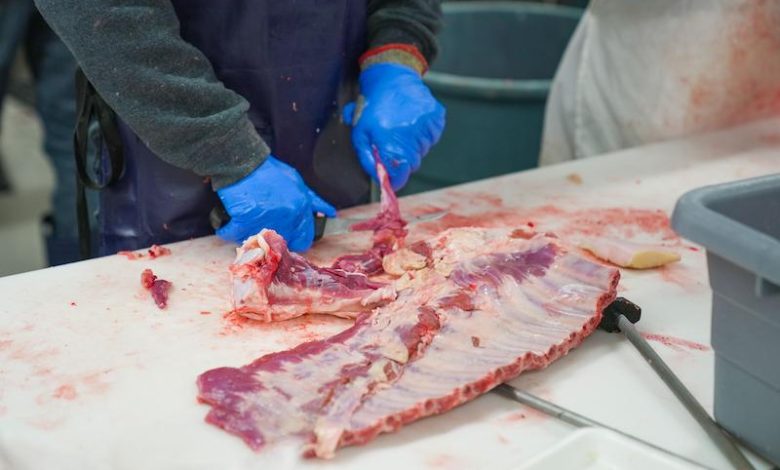
Few parts of a meat processing plant have more direct product contact than cutting and trimming stations. Knives, boards, tables and other equipment are repeatedly exposed as workers portion or prepare meat.
The obvious work surface usually receives close attention. The less obvious risk lies around edges, joins, equipment supports and spaces beneath tables where small pieces of tissue or liquid can travel during processing.
Repeated handling also means that contamination does not have to remain in one place. A worker may touch a tool, control or container before returning to the product. This makes the pattern of contact just as important as the visible condition of the work area.
When reviewing these stations it helps to follow a typical task from beginning to end. Every surface touched during that process can then be considered rather than focusing only on the table where the meat sits.
Conveyor Belts and Product Transfer Points
Conveyors are central to many processing operations because they move meat efficiently between stages. Their constant product contact also makes them an important area when considering contamination risk.
The belt itself is only part of the picture. Product residue can reach rollers, guides, supports and the underside of the conveyor. Transfer points where meat moves from one belt or machine to another can be particularly challenging because small pieces and liquids may fall into narrow spaces.
These locations can appear acceptable when viewed from normal standing height. A closer inspection from the side or underneath may reveal areas that are much harder to access.
Effective meat processing plant cleaning therefore needs to consider the whole conveyor structure rather than only the surface carrying the product. The same principle applies to chutes and other equipment used to transfer meat between processing stages.
Slicers, Grinders and Other Processing Equipment
Complex machinery introduces another challenge because product can enter gaps that are not immediately visible. Slicers, grinders and similar equipment contain multiple components that come into direct contact with meat.
Residue may collect around guards, blades, joints, seals and internal surfaces depending on the design of the machine. Cleaning only what is visible from the outside can leave difficult areas untouched.
Equipment design has a major influence on how easily these locations can be accessed. Some components may need to be opened or removed according to established procedures before all relevant surfaces can be reached.
This is why the appearance of assembled machinery can be misleading. A clean exterior does not automatically tell you what is happening around the components that handled product during the shift.
Drains and Wet Floor Areas
Water is essential to many cleaning processes but its movement through a meat processing plant deserves careful thought. As water crosses a floor it can carry organic residue towards drains and lower areas.
Drain covers, edges and nearby floor junctions can collect material that is not always obvious from a distance. Areas that remain wet also require attention because moisture changes the conditions of the environment and can make residue harder to identify.
There is another practical issue. Using water without controlling where residue travels can simply move material from one location to another. Splashing can extend the area affected rather than solving the original problem.
For that reason drains should not be viewed as isolated cleaning points. The surrounding floor, nearby equipment bases and the route that water takes towards the drain all form part of the same area.
Equipment Bases, Floor Junctions and Hidden Spaces
Open floors are generally easy to see and access. The spaces where machinery meets the floor are much more complicated.
Meat particles and liquid can travel beneath equipment or collect around fixed bases. Wall junctions, corners and narrow gaps between machines can create similar problems because normal cleaning tools may not reach them as easily.
These areas are worth viewing from different angles. Looking across the floor at a lower level can reveal residue that is almost invisible when someone is standing directly above it.
Plant layout also matters. Where equipment has been installed close together there may be spaces that are technically visible but difficult to clean properly. Identifying these limitations helps ensure that cleaning procedures reflect the actual environment rather than an idealised open floor plan.
Tools, Handles and Frequently Touched Surfaces
Not every higher risk surface is large. Some of the most frequently contacted items in a processing plant are relatively small.
Knife handles, taps, switches, control panels, door handles and trolley grips may be touched repeatedly during a shift. Gloves can also contact several different surfaces as workers move between tasks.
The important question is not simply whether a surface touches meat directly. It is whether contact with that surface could create a pathway between different activities or areas.
Observing how employees actually work can be valuable here. A written process may look straightforward but watching the sequence of movements can reveal frequently touched surfaces that are easy to miss when a cleaning plan is created from a desk.
Raw and Finished Product Transition Areas
One of the most important contamination considerations is the movement between areas handling raw meat and those handling products that have reached a later stage of processing.
People, tools, containers and mobile equipment can all move between zones. If those movements are not carefully considered they can create connections between spaces that are intended to remain separate.
Doorways and shared access points deserve particular attention because they concentrate movement into a small area. The same applies to trolleys or containers that travel through multiple sections of the plant.
Thinking in terms of routes rather than individual rooms makes these risks easier to recognise. A floor may be clean in both areas but the equipment moving between them can still create a link that needs to be managed.
Cold Rooms and Chilled Storage
Low temperatures do not remove the need for careful cleaning. Cold rooms contain shelving, pallets, door seals and storage equipment that can make some surfaces difficult to inspect.
Stock itself can restrict access. A floor beneath a loaded pallet or the wall behind full shelving may remain hidden until products are moved. Condensation and liquid from stored items can also reach floor edges and equipment supports.
Doorways deserve attention because they experience frequent traffic. Handles, seals and the floor immediately around an entrance may be contacted repeatedly as products and workers move in and out.
Coordinating inspection with stock movement can make hidden areas easier to manage. When a storage position becomes empty there is an opportunity to examine surfaces that are normally covered.
Waste Collection and Byproduct Areas
Meat processing naturally produces waste and material that needs to be removed from the production environment. The risk is not confined to the final waste collection point.
Bins, carts and containers travel through the plant while carrying material away from processing areas. Their wheels, handles, lids and outer surfaces can therefore become part of the wider contamination pathway.
Spillage can also occur during transfer. A small amount of material dropped beside a waste container may be obvious but residue underneath the container or around its wheels can be much easier to miss.
It is useful to follow the complete waste route through the facility. This reveals where waste handling crosses other movement pathways and which surfaces experience repeated contact along the way.
Staff Entry and Movement Points
People connect almost every part of a meat processing plant. Their movement can therefore influence contamination risk even in areas where meat is not directly handled.
Changing areas, footwear points, hand washing facilities and entrances to production zones all experience regular traffic. Benches, doors, lockers and surrounding floors may be touched or crossed by many employees during a shift.
The challenge is often timing. These areas may be busiest exactly when workers are entering or leaving production which can make cleaning access more difficult.
Understanding traffic patterns allows cleaning to be planned around how the workforce actually moves. It also helps identify transition points that may require more attention than quieter parts of the facility.
Contamination Risk Is About Movement as Much as Location
The highest risk areas in a meat processing plant cannot be identified simply by making a list of rooms. Risk follows movement. Meat travels through equipment, workers move between tasks, water flows towards drains and waste leaves the production area along established routes.
This is why a useful assessment starts by following those journeys. Trace raw product from receiving through processing. Look at every surface it touches. Follow the tools and trolleys used by workers then consider where water and waste travel at the end of production.
Doing this often reveals areas that are easy to overlook during a standard visual inspection. A conveyor support, trolley handle or doorway may seem insignificant on its own but its importance becomes clearer when viewed as part of a wider pathway.
The goal is not simply to identify which part of the plant looks dirtiest. It is to understand where contamination could be introduced, retained or carried elsewhere. When cleaning plans are built around those real patterns of movement the facility can give appropriate attention to the places where it matters most.